
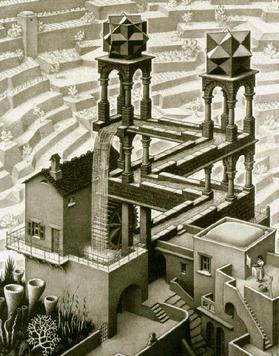
Although Escher did not have mathematical training—his understanding of mathematics was largely visual and intuitive—Escher's work had a strong mathematical component, and more than a few of the worlds which he drew are built around impossible objects such as the Necker cube and the Penrose triangle. Many of Escher's works employed repeated tilings called tessellations. Escher's artwork is especially well-liked by mathematicians and scientists, who enjoy his use of polyhedra and geometric distortions. For example, in Gravity, multi-colored turtles poke their heads out of a stellated dodecahedron.
